Thursday, May 5, 2016

Mezcal (Joven) Side X Side Blind Spring 2016 Taste-Off

With mezcal in sort of a holding pattern at the moment - with both new proposals NOM-070 and NOM-199 literally hovering over Mexico - I felt such a review was long over-due. If you have no clue what I am writing about just click over to my last post. It explains just some of the tactical maneuvering and politicking taking place behind the agave based alcohol spirits 'scene' in Mexico. We will not attempt to use the new categories suggested in NOM-070 to tag the particular brands after the tasting: 1). mezcal (industrial); 2). mezcal artesanal; and 3). mezcal ancestral. It's safe to say that most of these brands fall into 2 or 3 - or somewhere in-between artesanal and ancestral. If a brand or anyone disagrees with our assessment it can and will be corrected. Clay copitas, jicaras and Glencairn whisky glasses were used. Before sipping a dab of each mezcal was placed on the dorsum part of our hands for a quick initial first impression. 

Group 1:

Brand "B" - Dorsum: earthy - musty herbal (ginger?) - pipe tobacco - salty ocean spray? Aroma: roasted agave, very earthy, old leather, spicy nuttiness (cardamom?), subtle sweetness, flinty, briny, smoky tobacco, faint citrus note (orange rind?) Flavour: fresh cooked agave, some minerality, there's that spicy nuttiness (cardamom?), faint tobacco, hint of smoke, salty-caramelized sugar? Very oily upon entry that nicely coats the mouth accompanied with mild a numbness. A citrus herbal note lingers in the back - hard to peg. Finish: long - sort of grabs on for a bit then softens - with faint traces of flavours mentioned above but that cooked agave lingers on. Definitely worthy.

Brand "L" - Dorsum: perfumy - floral (rose?) - herbaceous. Aroma: earthy, faint roasted agave, hay?, wet clay, plaster?, faint fruit (pear?), some fennel or anise, traces of smoke, floral (rose again?), some spiciness. Flavour: cooked agave, very earthy (dirt), green apple?, herbal (more anise), rose hips?, spice (cinnamon), hint of ash. Semi-oily upon entry - that transitions from sweet agave to a slight alcohol sting to dry tart (cherry?) snap at the back of the mouth. Some lip, gum and mouth numbness - some of the flavour nuances rolled up to the nasal passage. Finish: long - faint smokiness, a dry spicy sweetness returns toward the back of the mouth and throat. The lingering burn is actually nice and soft. There is a lot of complexity going on with this one.

Brand "G" - Dorsum: deep earthiness - worn old leather - briny. Aroma: fresh roasted agave, grassy, mushroom? (dried morel?), some herbal, citrus, wet slate?, hint of scorched peat? subtle alcohol. Flavour: soft roasted agave, very earthy, black olives, mushroom?, overripe fruit(s) (banana and apricot?), a soft smoky wood (cedar?) note. Very viscous upon entry with mild lip, gum and mouth numbness - get a spicy nutty thing and some alcohol in the back. Finish: medium long, mild sweetness, fruity (banana and apricot?), subtle ash hint, notice that spicy nutty thing more, while maintains that earthiness. Where did the olive, mushroom, nutty notes come from?  Definitely enjoyable while many flavours keeps you guessing. 

Brand "E" - Dorsum: herbaceous - beef-jerky? - hints of fruit (melon?) - musky pipe tobacco? Aroma: loads of fresh cooked agave, cheese (parmesan?), lemongrass, spicy cinnamon hard candy (think Hot Tamales), buried under all of that is subtle scorched mesquite (reminiscent of carne asada bbq?) Flavour: roasted agave, minerality (wet rocks?), mild beef-jerky?, spicy cinnamon. Semi-oily upon entry - pleasant numbness on the lips, gums and mouth - all flavours  mentioned act in unison fairly well - the beef-jerky note lingers somewhere in the back? Finish: long - dry - soft roasted agave - tobacco again? and can't help but notice that beef-jerky component. This definitely could be a meal substitute. Hats off to the master distiller and palenque. 

Group 2:

Brand "I" - Dorsum: herbal (pine?) - flinty. Aroma: strong roasted agave, burnt caramel?, wet rocks, herbal (rosemary or pine?), floral (daffodil?). tobacco (lit cigar?), incense (burnt sandalwood?) Flavour: loads of roasted agave, sweet (raw honey), some spiciness (black pepper), orange rind, caramelized brown sugar. Semi-oily upon entry - sharp numbness in the mouth - lips tingle, that softens out with some sweetness. Notice a smoky citrus spicy component at the back of the mouth and down the throat. Finish: medium - somewhat dry with some saltiness - maintains some earthiness, almost find a smoky menthol component. Would make a great dessert spirit or maybe an apéritif. Pleasing.

Brand "D" - Dorsum: ripe fruit (mango?) - floral. Aroma: cooked agave, butter & honey, mild smoke - hint of sulphur, winter rye seed?, minty, vanilla?, sugared mango, yellow dandelion? Flavour: loads of roasted agave, scorched earth, fruitiness (there's that mango again), herbal-mint (marjoram?), cinnamon? Viscous upon entry with a smoky sweet tangy thing going on - roll a sip around the mouth - with mild numbness on lips. gums and mouth rooftop - notice a tug of cinnamon-mango in the back area. Finish: long and pleasant, oily, almost chewy with some lingering cinnamon notes? Nicely done.

Brand "H" - Dorsum: spicy - herbal - leather - fruit (apricot?). Aroma: roasted agave, earthy (wet clay?), layered herbal notes (clove and sage?), citrus (ripe orange), heather honey, varnish?, mild almost soft smokiness, fruity. Flavour: roasted agave, earthy (wet clay?), briny, vegetal (spinach?), adhesive (Elmer's glue-stick?), nice clove note and hint of smoke and alcohol in the back. Really viscous upon entry - with a not to subtle stinginess and numbing of the lips, gums and mouth that eventually mellows out nicely with sweet citrus notes (sort of reminds me of biting into a raw serrano chile then eating a slice of orange dabbed in yellow honey?) - then out of nowhere notice some epazote? Finish: long - mild alcohol bite - spicy and herbal. Really impressed with the intensity and some odd flavours. Very challenging.

Brand "A" - Dorsum: earthy - very herbacious - mild fruit (citrus). Aroma: earthy (wet clay?), mild sweetness (raw honey), herbal (fennel?), fruit (almost acetone?). Flavour: roasted agave, spicy (pepper), smoky, flinty, mango with ripe citrus tones (lime and orange peel?), and a subtle smokiness. Semi-oily upon entry - roll a sip around the mouth - and get a nice unison of above mentioned flavours accompanied with a lingering numbness in the whole mouth. Noticed some black licorice at the back-end of the mouth. Finish: long - dry with an earthy bite. Very pleasing. 

Group 3:

Brand "F" - Dorsum: briny - spicy - grassy - leather. Aroma: roasted agave, vegetal (radish?), floral (chamomile?), barbecued jalapeno, herbal (chamomile tea?), slight ash, burnt cedar?, mild sweetness, Flavour: roasted agave, earthy, spicy (jalapeno?), citrus (orange?), nutty espresso (salty toasted almond with vanilla?), Semi-oily upon entry - mild numbness in the mouth - with a spicy herbal, smoky ash, burnt wood thing lingering in the back. Finish: medium, soft alcohol bite - somewhat tart - fruity - nutty. Not overtly complex but pleasant. 

Brand "J" - Dorsum: herbal ( thyme?) - butter - peppermint tea. Aroma: mild roasted agave, earthy (wet rocks?), cotton candy?, green apple, fig newton?, minty tobacco?, Flavour: fresh cooked agave, buttery, slight brininess, Semi-oily upon entry - sharp numbness in the mouth that mellows out with some sweetness. Notice a smoky herbal (pine?) note at the back of the mouth and down the throat. Finish: medium - somewhat dry - maintains some earthiness, almost find a smoky menthol component. Would make a great dessert spirit or maybe an apéritif. Pleasing.

Brand "K" - Dorsum: earthy - smoky (slightly burnt cedar wood?) - medicinal/floral (eucalyptus). Aroma: roasted agave, earthy, slightly herbal (oregano?), aloe vera sap?, mild alcohol. Flavour: lots of roasted agave, fresh rich earthiness, some sweetness, anise, ripe pear, Semi-oily upon entry - flinty - soft numbness on the lips, gums and mouth - accompanied with a warm, aromatic, slightly bitter, and camphoraceous taste (eucalyptus?) in the back of the mouth and throat. Finish: medium to long - dry - salty, tangy, smoky (kind of like old style barbecue potato chips?), hint of alcohol. It was a symphony of congenial flavors.

Brand "C" - Dorsum: musky - old leather - sweet dry hay - herbal - smoky homemade barbecue sauce? Aroma: cooked ripe agave, herbal, (dried lavender?), earthy (hint of scorched peat?), honeysuckle nectar?, subtle alcohol. Flavour: nice roasted agave, slight grassiness, spicy (serrano chile?), minty, hint of rosemary, white pepper, mild sweetness, citrus (orange peel?). Semi-oily upon entry - mild tingling on the lips and in the nasal passage, some numbness on the gums and mouth - peppery spiciness and mild smokiness drifts away when a sweet honey like taste comes from nowhere (honeysuckle nectar?). Finish: medium - dry - hint of alcohol while maintaining some fresh earthiness. Could gently sip this all night with tacos, salchichas and papas.


Having enjoyed these mezcals for some time and accumulated so so many tasting notes, decided to randomly select and break them down into three groups to revisit. Decided that one group per day was plenty to avoid any palate fatigue. It was a joy to revisit some that we forgot about and surprised that some aromas and flavours had changed somewhat, but all in all these are some solid offerings. It definitely reminds you that mezcal is kicking tequila's ass in the complexity department. Some of these are available outside of Mexico.


The particular brands are: Guelaxu cuishe 48% Abv. (A), La Orden Del Sol espadin 45% Abv. (B), Lagrimas de Delores durangensis 45% Abv. (C), La Medida tobala 47% Abv. (D),  Augurio tobala 47% Abv. (E), Bosscal durangensis 42% Abv. (F), Don Esther papalome 54% Abv. (G), La Porfiria papalote 52% Abv. (H), Rio Revuelto ensamble (50% espadín & 50% madrecuixe) 47% Abv. (I), Barro de Cobre espadin 43% Abv. (J), Casa Crespo madrecuixe 50% Abv. (K), El Rey de Matatlán madrecuixe 50% Abv. (L). 


Wednesday, April 20, 2016

NOM-199. Alcohol Laws: A Looming Change For Agave Spirits In Mexico. Is it Vino de Mezcal? Is it Tequila? Is it Mezcal? Is it Destilado de Agave? Is it Aguardiente de Agave? Is it Bacanora? Is it Raicilla? Is it Sotol? Is it Komil? 


What came first, tequila or mezcal? What about their denominaciónes de origen? Yes, there is a separate denominación de origen for each agave (maguey) based alcoholic spirit: tequila, mezcal, bacanora, and sotol (Dasylirion wheeleri is now in a different family category). Currently, raicilla does not have its own denominación de origen. An agave based spirit produced outside any of these denominaciónes de origen is technically classified as a destilado de Agave (apparently this is about to change). Besides the DOs, there are various NOMs (Norma Oficial Mexicana) - laws passed by Mexico's federal government - which stipulate rules and regulations that these type of spirits must adhere to. Back to the first question, what came first, tequila or mezcal? Any idea? Does it really matter? One tequila company loves to use the "beginning in Tequila, Mexico" and "founded in 1795" historical tidbits, yet fails to mention anywhere on their label it has the biggest diffuser in all of Mexico at one of its two distilleries. It's unbelievable that the Spanish assumed the indigenous people didn't have the means, knowledge or capability of producing alcoholic spirits through various means of fermentation and distillation. Perhaps, the Spanish were selectively ignorant. Maybe the Spanish destroyed all the indigenous people's tools for distillation and all records of it. Clay pots can be used. Apparently a tree trunk can be used. Is the tequila narrative built under false pretense(s)? What about all the archaeological research exploring the possibility of pre-Hispanic distillation? To be honest seeing as the governing bodies within Mexico certified Zignum as mezcal, doubt they'd construct news laws to actually protect such a cultural treasure - much less support any such investigative research.


Agave based spirits have always enjoyed a relatively warm appreciation around the globe. It's no secret that for decades bulk mixo-tequila has been shipped, bottled, and labeled as Tequila in other countries outside of Mexico. It's claimed that the "U.S. is Mexico’s largest export market for tequila, accounting for 50 percent of Mexico’s total production," A few things happened along the way towards the 21st century. The rise in popularity of 100% agave premium tequila around the mid-late 1980s to early 1990s. On December 20, 1994, the Mexican government devalued the peso. Then in the late 1990s the agave crisis kicked in, and prices skyrocketed. Tequila producers paid around 7,000 pesos for a ton of agave. Some producers shifted production to mixto-tequila only to offset costs. A new tequila NOM that permitted the use of industrial diffusers in the production methods. Insert celebrity, actor, professional athlete, or musician owned private brand here. Various brand endorsements. Medals and spirits competitions. The sudden appreciation outside of Mexico for traditionally made 100% agave mezcal. The gradual genetic weakening of the Agave tequilana due to over-reliance on asexual reproduction. Allegations abound that tequila companies were illegally procuring Agave from outside their denominación de origen. The continuous over-harvesting of wild agave and no real reforestation initiatives. Once upon a time, companies and investors rushed at the chance to purchase or start a tequila brand. Now mezcal is the new black, with the likes of William Grant & Sons (Montelobos), Diageo (Unión), David Ravandi (123 Organic Tequila and ex-owner Casa Noble Tequila), Riazul, La Cofradia, Mexcor and Casa Cuervo (400 Conejos and Creyente) getting involved with a mezcal brand. All the while, the Mexican government steps in and tables proposals NOM-186, NOM-070, and NOM-199.


In 2011, a proposed legislation called PROY-NOM-186-SCFI-2011, Bebidas Alcohólicas, Bebidas Alcohólicas Elaboradas a Partir de Agaváceas was tabled for discussion. NOM-186 intended to trademark the word "agave". It dealt with the regulation of distilled agave spirits in Mexico and proposed the exclusive use of the word agave for processed products and registered designations of origin mezcal, tequila and bacanora.  For example, a mezcal producer outside the DO mezcal could only call their spirit aguardiente or destilado de agaváceas. They could not declare the sugar content of agave that the spirit is made from, even if it was 100% agave. Basically they could not produce traditional mezcal (a 100% agave spirit with an alcohol content between 40 and 55 percent), but could produce a somewhat inferior lower alcohol proof product. Fortunately, NOM-186 did not pass into law. But who would throw their support behind such a restrictive proposal?


Correspondence from Don Julio supporting the NOM-186 proposal. At that time Casa Cuervo and Diageo jointly owned (50/50) Don Julio tequila

Master distiller José Manuel Vivanco at Destileria El Ranchito Feliciano - Vivanco y Asociados (NOM 1414) praised National Chamber for the Tequila Industry (CNIT) and COMEFER's attempts to trademark "agave"


Back in 2012, Luis Velasco Fernández, President and CEO of La Madrileña, S.A. de C.V. (NOM 1142) expressed opposition to NOM 186. Don Luis Velasco Fernández, became new president of the National Chamber of the Tequila Industry (CNIT) in 2015. 

How can a binomial nomenclature be trademarked? Agave is part of the binomial nomenclature system. It is commonly understood and accepted that a binomial nomenclature can not be trademarked. What's intriguing and bewildering is that both CNIT (Camara Nacional de la Industria Tequilera) and CRT (Consejo Regulador del Tequila) have attempted or are attempting to trademark "agave".


Then sometime in 2014 - 2015 the Mexican government with the assistance of CRM (Consejo Regulador del Mezcal) tabled a proposal to update the Proyecto de Norma Oficial Mexicana NOM-070-SCFI-1994, Bebidas Alcohólicas-. Mezcal-Especificaciones with Proyecto de Norma Oficial Mexicana PROY-NOM-070-SCFI-2015, Bebidas alcohólicas-Mezcal-Especificaciones. NOM-070 appeared to be a genuine attempt by CRM and its president, Hipócrates Nolasco Cancino, to reach out and consult with mezcaleros and families inside the  mezcal  denominación de origen to clearly define the specific categories of 100% agave mezcal (the 80% agave mezcal was going to be eliminated): 1). mezcal (industrial); 2). mezcal artesanal; and 3). mezcal ancestral. The raw material must undergo the following procedure(s) as stated in the NOM for each category to qualify as that specific mezcal. Still unclear whether the use of an diffuser would still be permitted in the mezcal (industrial) category.


Then just a few months after the PROY-NOM-070-SCFI-2015, the federal government of Mexico - Secretaría de Economía - released a proposal, Proyecto de Norma Oficial Mexicana PROY-NOM-199-SCFI-2015, Bebidas alcohólicas-Denominación, especificaciones fisicoquímicas, información comercial y métodos de prueba, that would completely overhaul all alcoholic spirits produced, bottled and imported inside the Estados Unidos Mexicanos. It is definitely a bold move by the government of Mexico. One could argue it is a heavy-handed attempt of compromise protectionism or perhaps something else entirely. A study by Euromonitor International did find that a staggering 43 per cent of the spirits consumed in Mexico were untaxed and illegal - either faked, contraband, unregulated or the product of under-invoicing. So where does that leave PROY-NOM-070-SCFI-2015? NOM-199 revisits the exclusive use of agave from NOM-186. A spirit produced outside any denominación de origen that uses agave as a raw material would now be categorized as komil - with no allowed mention of what variety of agave was used or the percentage of agave used. A spirit in the komil category would only need to be made from 51 percent agave. In other words it could be very difficult for the consumer to differentiate on the label between a small producer distilling a 100 percent agave spirit and an industrial producer manipulating their spirit with 49 percent sugar cane or corn syrup. Again, ask yourself, who would support such restrictive measures? Ildefonso Guajardo Villarreal, a Institutional Revolutionary Party (PRI) politicain, and Luis Velasco Fernández, the president of the National Chamber of the Tequila Industry (CNIT) appear to support NOM-199,


I understand restricting the use of the words tequila, mezcal, bacanora etc. (must respect denominaciónes de origen), but it's ridiculous to restrict the use of agave. Why not allow producers outside the denominaciónes de origen to use destilado de agave. For the small families producing agave spirits (up to 200 litres per month*) in a DO, but unable to pay the full fees and monies to the organization overseeing certification for that denominaciónes de origen, why not permit the use of destilado de agave or permitted name in that DO. Maybe create some sort of cooperative  for such families in the DOs, but if this already exists perhaps expand on it. Again, an argument can be made where agave is a binomial nomenclature which can not be trademarked or even its use restricted for that matter. Unfortunately, it appears Camara Nacional de la Industria Tequilera, Consejo Regulador del Tequila, Consejo Regulador del Mezcal, Consejo Sonorense Promotor de la Regulación del Bacanora, and various national, multinational and transnational corporations have all thrown their support behind NOM-199. Respected scholar, Patricia Colunga García-Marín, wrote this response to NOM-199. But this letter in opposition to NOM-186 said it best: 

"Este proyecto, al igual que el propuesto por el Instituto Mexicano de la Propiedad Industrial (IMPI), para declarar la palabra Agave como una marca de uso exclusivo de los productores de las DO Tequila, Mezcal y Bacanora (Expediente No. 08/0116/171011), pretende establecer normas legales que, de ser aprobadas, significarían: 1) La violación del derecho del consumidor de contar con información adecuada y clara sobre los productos que adquiere, los cuales deben especificar de forma correcta su cantidad, características, composición, calidad y precio, 2) La exclusión de cientos de productores de mezcales artesanales tradicionales del mercado de bebidas alcohólicas, vulnerando así la garantía prevista en el Artículo 5º de nuestra Constitución, que señala que a nadie se le podrá impedir que se dedique a una profesión, industria, comercio o trabajo lícito, y 3) La destrucción de una parte del patrimonio biológico y cultural de los mexicanos, violando los convenios internacionales que sobre la materia han sido firmados por nuestro país."

"This project, as proposed by the Mexican Institute of Industrial Property (IMPI), to declare the word Agave as a mark of exclusive use of the producers of the DO Tequila, Mezcal and Bacanora (Docket No. 08/0116 / 171011), it aims to establish legal rules that, if approved, would mean: 1) the violation of the right of consumers to have adequate and clear information about the products you purchase, which must be specified correctly quantity, characteristics, composition, quality and price, 2) the exclusion of hundreds of producers of traditional artisan mezcal market of alcoholic beverages, thus breaching the security provided for in Article 5 of our Constitution, which states that no one shall be hindered engaged in a profession , industry, trade or legal work, and 3) the destruction of a part of the biological and cultural heritage of Mexicans, violating international conventions on the subject have been signed by our country."


Is this NOM-199 a sign of the impending apocalypse for agave spirits? Will the big corporations flood the markets with komil? What's strange is the consumers are not as upset with the gradual industrialization of tequila and mezcal. It seems a new flavoured tequila (mixto and 100% agave), produced at a distillery with a diffuser, is being released every odd month. I cannot imagine all of this proposed NOM will be enacted into law. I predict that komil will be redacted. Everyone will have to respect the ever-so-often-expanded DOs, If an 100% agave spirit is produced outside the denominaciónes de origen it should be allowed to be called  destilado de agave or destilado de maguey. If an 100% agave spirit is produced inside a denominaciónes de origen without the proper certification but exported for sale... well I'm not going there. All spirits producers should be monitored and have strict testing certification - obviously costs adjusted according to production size. Maybe ease up on the alcohol proof restriction. Eliminate the mixto category - only 100% agave. Prohibit diffusers. Expand the DOs, at the very least the inclusion of other states/regions could address some concerns about monitoring, inspections and quality. There should be sizable tax benefits to producers that: 1). adopt a reduce, reuse, recycle program; 2). have a low carbon footprint; 3). only manufacture up to 200* litres per month and 4). have an active and successful program for reforestation of agave. Besides, producers only making small batches of spirits through ancestral methods should be rewarded. Producers using industrial methods (ie. diffuser) to make thousands of liters a month should be strictly monitored. If you feel compelled to sign a petition to support opposition to NOM-199 for agave distillates - there is this one created by Tequila Interchange Project.

And for whatever reason, a few individuals and a company have jumped at the attempt to trademark "komil". And then there's Carl´s Jr.'s Mezcal BBQ Thickburger. I don't have a horse in this race. Definitely not an expert. I don't make a living off of the industry. I do enjoy all agave based spirits. The history of pre-hispanic Mesoamérica fascinates me. The story of Mayahuel and Centzon Totochtin. The story on the discovery of pulque. The making of pulque (fermentation and agave). Don't even get me started on the many varieties of corn (maize) and the possibility of a corn whisky-type spirit. NOM-199 is a flimsy attempt to strong-arm the ancestral and traditional spirits producers which just so happens to include a large portion of indigenous people in Mexico's poorest rural regions. Sort of sounds like 1795 all over again...so what came first, tequila or mezcal?

* 200 litres is just a random number thrown out there. The mezcaleros producing spirits through ancestral methods would have a better idea to quantify what "small batch" means when it comes to such numbers involving monthly production


El Mezcalito, a great example of the hypocrisy in this fight. Claims to contain Agave. Yet made with Caña de azúcar (sugar-cane). And what about the brand's name?


While the government of Mexico is so worried about the use of mezcal - Carl´s Jr. nonchalantly uses it for their new Mezcal BBQ Thickburger.


Wild Agave Imports, LLC is a subsidiary of Wahaka Mezcal


Monday, December 14, 2015

A Boring List of Possible Agave Spirits to Purchase over the Upcoming Holidays


It's that time of year again. I realize that over the holidays buying booze is basically a fleeting thought with all the gift shopping and all. But perhaps you'll find yourself standing in the whiskey aisle or god forbid the vodka aisle contemplating what to purchase. Maybe a nicely aged Tequila. Or maybe a Mezcal. Great thing about Agave spirits is they are a versatile ingredient. Make some margaritas over the holidays. Then there is the troubling task of gifting of a bottle to someone. I will give a few suggestions and hopefully stay within a modest budget. I realize that the selection could be thin where ever you are located so I've named off a bunch of different brands in no particular order.

Extra-Añejo Tequila: 
  1. Tapatio Excelencia 
  2. Siete Leguas D'Antaño
  3. Casa Noble Single Barrel 5 Year (for some reason labeled as an Añejo) 
  4. Toro de Lidia (bargain)
  5. Arta (triple barrel aging)
  6. El Viejito
  7. Arette Gran Clase
  8. San Matias Gran Reserva
  9. Pura Sangre 5 Year Old
Añejo Tequila:
  1. Don Pilar
  2. Siete Leguas
  3. Calle 23 (NOM1529)
  4. Orgullo Pueblo Viejo
  5. Semental 
  6. Santoyo Grand Leyenda
  7. Tapatio
  8. Centinela (*older round bottle presentation)
  9. 4 Cañones
  10. Arette (bargain)
  11. Crotalo
  12. Siembra Azul
  13. Herencia de Plata
  14. El Tequileno Especial - 50 Aniversario
  15. Los Tres Toños
  16. Gran Dovejo
  17. Tres Ochos 888
  18. SINO
  19. Reserva de los González
  20. Purasangre 
  21. Mañana
Reposado Tequila:
  1. Fortaleza
  2. Tapatio
  3. Siete Leguas
  4. Don Nacho (bargain *regular line*)
  5. Calle 23 (NOM1529)
  6. Don Fulano
  7. Hacienda Vieja (bargain)
  8. Olmeca Altos (bargain)
  9. Lunazul "Double Barrel"
  10. Casa Noble
  11. Crotalo
  12. Muchote (apparently brand has been resurrected) 
  13. Don Pilar
  14. Centinela (*older round bottle presentation)
  15. Rancho La Joya
  16. Cimarrón (bargain)
  17. Creencias
  18. Arette (bargain)
  19. Los Tres Toños
  20. 29 Two Nine
  21. Gran Dovejo
  22. Cabresto
  23. Herradura Colección de la Casa, Reserva 2014 – Scotch Cask Finish
  24. Reserva de los González
  25. Purasangre
Blanco Tequila:
  1. Tapatio (80 Proof and 110 Proof)
  2. Fortaleza
  3. Siete Leguas
  4. G4
  5. Don Chencho (110 Proof)
  6. Pura Sangre
  7. Astral (86 Proof)
  8. Don Nacho (bargain *regular line*)
  9. Olmeca Altos (bargain)
  10. Cascahuin (bargain) if not available go with Siembra Valles
  11. Arette (bargain)
  12. Cimarrón (bargain)
  13. Los Tres Toños
  14. Kirkland 1.75L (NOM1472)
  15. Gran Dovejo
  16. Centinela (*older round bottle presentation)
  17. Casa Noble
  18. AquaRiva
  19. El Viejito (110 Proof)
  20. Reserva de los González
  21. Calle 23 (NOM1529)
  22. Hacienda Vieja (bargain)
Mezcal: 
  1. Del Maguey Chichicapa (Espadin)
  2. Mezcaloteca Mexicano (beef jerky)
  3. Rio Revuelto Ensamble
  4. Augurio Tobala
  5. Vago Olla de Barro Tobalá (*grab it if you find a bottle in the wild*)
  6. Alipus San Juan (Espadin)
  7. Don Amado
  8. Bosscal
Bacanora: 
  1. Don Beto Joven (sold in the USA as La Niña del Mezcal's Bacanora D.O. Sonora)
  2. Los Cantiles Joven


HAPPY HOLIDAYS AND FELIZ NAVIDAD

Friday, December 4, 2015

Dedini S/A Indústrias de Base built linear difusor

The Brazilian Experience: Rum, Cachaça and Difusores (Diffusers)


I'll be the first to admit that I am a complete novice when it comes to rum, and cachaça for that matter. It's interesting to stumble upon another manufacturer of difusor (diffuser) technology used in conjunction with the fermentation, and distillation processes for the production of rum (Cachaça). In a prior post, I pointed out that this type of agave sugar extraction technology was fairly new in the tequila and mezcal industry. The linear difusor built in Brazil looks strikingly similar to the Spanish built difusor used in the production of tequila, mezcal, brandy, wine, rum etc. as well. I approached a few so-called rum "experts" about this technology only to be rebuffed. I even got an unexpected fairly negative response from a Bacardi ambassador - which is sort of funny seeing how Bacardi does use a difusor at its distillery in Mexico - Bacardi Y Compañia - Tequila Cazadores De Arandas, S. De R.I. De C.V.


Apparently the first difusor (bagasse type) and milling process used in Brazil was sometime around 1967. Up until 1968, all sugarcane juice extraction systems consisted of just a milling process. Apparently, this bagasse type difusor was scrapped for a more efficient cane difusor milling process. This story certainly sounds familiar with the difusor technology in tequila and mezcal production - maximize the extraction of desired sugars from agave pinas before fermentation and distillation - but in this case just substitute sugarcane or molasses for agave pinas. According to Tomsa Destil, the Spanish difusor maker, this sort of technology can be to be used with molasses. The difusor is used somewhere in molasses treatment phase.


It seems the main manufacturer behind these sugarcane difusores is a Brazilian company named Dedini S/A Indústrias de Base. There are two types of difusores built by Dedini S/A Indústrias de Base - a linear diffuser with a movable screen and a fixed screen linear diffuser. Both types are used in the cane processing plants in Brazil - some produce sugar, ethanol and bioelectricity while others are designed for energy production, ethanol and electricity. Now it's hard to pin down an exact number currently in use for rum (Cachaça). Dedini S/A Indústrias de Base's website states that 15 of its difusores are currently in use in Brazil. Then if you just geek out some more and ask the obvious questions: How many of the 15 are being used for the purpose of producing rum (Cachaça)? Do these difusores use an acid catalyzed hydrolysis process to capture more sugars from the sugarcane? Does this technology in anyway affect the flavour? And how many turnkey difusores built by this Brazilian company have been exported to enterprises outside of Brazil for the sole purpose of aiding in alcohol production? It's rather alarming...


Tuesday, December 1, 2015


Tres Ochos - 888 Tequila NOM 1472 (40% Abv.)


Tres Ochos tequila comes from Fabrica de Tequila Finos, S.A. de C.V. located near the old railroad station in the city of Tequila in Jalisco. This particular distillery was built sometime around 2000. The owners, Federico Cabo and Luz Maria Cabo, have been involved in tequila production since 1984. Supposedly they owned a position in Tequila Eucario Gonzalez, S.A. de C.V. and its Santa Cruz distillery (NOM 1113) in the 1980s. I have no clue if this particular distillery still exists or if it still produces tequila for that matter. Tequila Eucario Gonzalez had been in existence since the 1940s. Having been involved in the tequila industry for some 30+ years, it's a safe bet the Cabo family (along with their master distiller Arturo Fuentes) knows a thing or two about tequila. Search the records, and you'll notice about 25 brands of tequila come from Fabrica de Tequila Finos. Does that mean anything? I'd guess most are house brands with the odd private label (maquila) - like Tres Ochos. Off the top of my head, I've tried a few marcas from Fabrica de Tequila Finos - Kirkland, Agave 99 and KAH (which once was a maquila but now a distillery house brand). The KAH brand's skull trademark design is currently under a legal dispute. What's strange, but probably not when naming a tequila, is that two Tres Ochos have existed over the years/decades, albeit from different distilleries, Tres Ochos (Tequilas del Senor, S.A de C.V. NOM 1124) and Tres Ochos (Destilería Hacienda La Tarea unknown NOM).

Tequila Tres Ochos procede de Fábrica de Tequila Finos, S.A. de C.V., la cual se encuentra localizada cerca de la antigua estación de ferrocarril en la ciudad de Tequila, Jalisco. Esta destilería fue construida alrededor del año 2000. Sus dueños, Federico y Luz María Cabo, han estado involucrados en la producción de tequila desde 1984. Supuestamente, fueron también accionistas de Tequila Eucario González, S.A. de C.V. y su destilería Santa Cruz (NOM 1113) en los años ochenta. No tengo idea si esta destilería aún existe o si aún produce tequila. El Tequila Eucario González había existido desde la década de 1940. Después de haber participado por más de treinta años en la industria del tequila, es seguro que la familia Cabo (junto con su destilador experto Arturo Fuentes) sabe una o dos cosas sobre tequila. Si uno busca registros encontrará que cerca de 25 marcas de tequila se originan en Fábrica de Tequila Finos. ¿Significa esto algo? Supongo que la mayoría son marcas de casa con alguna etiqueta privada (maquila) – como es el caso de Tres Ochos. Sin reparar mucho, he probado algunos productos de Fábrica de Tequila Finos – Kirkland, Agave 99 y KAH. Existe una interminable disputa entre el tequila KAH de Fábrica de Tequila Finos y otra marca de tequila sobre el uso de una botella con diseño de cráneo. Pero esa es otra historia. Lo que es extraño, pero no cuando se trata de nombrar un tequila, es que dos marcas Tres Ochos han existido durante años/décadas, no obstante pertenecen a diferentes destilerías, Tres Ochos (Tequilas del Señor, S.A. de C.V. NOM 1124) y Tres Ochos (Destilería Hacienda La Tarea NOM desconocida).


If Fabrica de Tequila Finos, S.A. de C.V. was built around 2000 then it's probably safe to assume this distillery is more modern but not as industrialized as some of the newer ones being built today. The distillery uses ripe estate-grown blue agave from several of their plots of land around Tequila. No clue if this distillery sources blue agave from the open market or from small farmers around Tequila. Once the pinas arrive at the distillery where workers cut the agave into quarters. The pina quarters are placed inside large stainless steel autoclaves by workers with the aid of a small conveyor belt. Then the agave is slowly roasted in the autoclaves for 24+ hours.

Si Fábrica de Tequila Finos, S.A. de C.V. fue construida alrededor del año 2000 entonces es seguro asumir que esta destilería es más moderna pero no está tan industrializada como algunas de las que están siendo construidas hoy. Esta destilería usa agave azul maduro proveniente de varios de sus terrenos en Tequila, mas desconozco si obtiene más agave azul desde mercado abierto o pequeñas granjas alrededor de Tequila. Una vez que las piñas llegan a la destilería donde los trabajadores cortan el agave en cuartos. Los cuartos de piña son colocados dentro de grandes autoclaves de acero inoxidable por los trabajadores con la ayuda de una pequeña cinta transportadora. Después el agave es tostado lentamente en las autoclaves por más de 24 horas.


Once the the cooking and cooling phase is complete the cooked agave quarters are transported to the shredding machinery where the pieces of cooked agave are broken down into smaller pieces to facilitate the milling phase (molienda). The pressing/rolling action is complimented with the injection of water in strategic locations optimizing sugar extraction and the agave is squeezed to separate the juices from the fibers. It's worthwhile to note that Fabrica de Tequila Finos has adapted a more green approach when dealing with byproducts and residues produced at its distillery with some type of "tratamiento de vinazas" and bagazo program.

Cuando las fases de cocinado y enfriamiento están completas, los cuartos de agave son trasladados a la máquina de rallar donde las piezas de agave son descompuestas en pedazos más pequeños para facilitar la fase de molienda. El prensado y enrollado se complementan con la inyección de agua en locaciones estratégicas optimizando la extracción de azúcar y el agave es exprimido para separar los jugos de las fibras. Vale la pena señalar que Fabrica de Tequila Finos ha adoptado un enfoque más ecológico cuando se trata de derivados y residuos producidos en su destilería usando algún “tratamiento de vinazas” y programa de bagazo.


Fermentation takes place in one of the distillery's large stainless-steel tanks (50000L capacity?) most likely using a proprietary yeast. Assume no enzymes or additives are used in this process. It takes approximately 3 to 5+ days to complete the fermentation process.

La fermentación toma lugar en uno de los grandes tanques de acero inoxidable de la destilería (¿cuya capacidad es de 50000 litros?), y lo más probable es que se use una levadura hecha especialmente para la destileria. El proceso de fermentación toma aproximadamente entre 3 y 5 días completarse.


Once the fermentation is complete the next step is the distillation process. Fabrica de Tequila Finos has large stainless-steel pot stills with small stainless condensation tanks. It seems Fabrica de Tequila Finos' brands are produced with double or triple distillation process. Tres Ochos is the result of a two distillation process. No clue if this distillery distills to proof or distills to a higher proof then adds water to dilute to desired proof. There is a brand in this distillery's stable that is 49.5% Abv. (99 Proof).

Después de que la fermentación termina el siguiente paso es el proceso de destilación. Fabrica de Tequila Finos posee alambiques de acero inoxidable con pequeños tanques de condensación. Al parecer las marcas que pertenecen a Fábrica de Tequila Finos son producidas con un proceso de destilación doble o triple. En su caso, Tres Ochos es el resultado de dos procesos de destilación. No sé si esta fábrica destile grados prueba o si destile hacia grados mayores y después agregue agua para diluir la graduación deseada. Hay una marca estable en esta destilería que tiene 49.5% volumen de alcohol (99 prueba).


There is probably a wide variance in the aging process of the different tequila brands at Fabrica de Tequila Finos and what type of barrels used. Tres Ochos Reposado is aged an average of 11 months in oak barrels. Tres Ochos Anejo is aged around three years in smaller oak barrels. I have a few guesses what type of barrels were used for the aged Tres Ochos offerings. On their company website, one can't help but notice large stainless-steel tanks (135000L capacity?) near the pot stills. Couple of guesses about this: the blanco distillate is immediately tanked until needed for filtering and bottling; and various barrel aged tequila is dumped and blended accordingly in the tanks prior to filtering and bottling. Another tidbit is that I have no clue what proof the tequila is when placed inside the barrels. The barrel aging facility appears to be a brick structure with a curved metal roof and environmentally controlled. The bottling facility seems rather modern.

Probablemente hay una amplia variedad en el proceso de añejamiento de los diferentes tequilas de Fábrica de Tequila Finos y el tipo de barriles que usan. Tres Ochos Reposado es madurado en promedio 11 meses en barriles de roble. Tres Ochos Añejo es también madurado en pequeños barriles de roble por tres años. Tengo algunas suposiciones sobre el tipo de barriles que son usados para añejar Tres Ochos. En el sitio internet de su compañía, uno no puede evitar notar grandes tanques de acero inoxidable (¿1350000 litros de capacidad?) cerca de los alambiques. Dos hipótesis sobre esto: el destilado blanco es inmediatamente depositado hasta que se necesite filtrarlo y embotellarlo; varios tequilas madurados en barril son depositados y combinados en los tanques antes de filtrar y embotellar. Otro detalle que ignoro es el nivel de prueba que tiene el tequila cuando es puesto en los barriles. Las instalaciones de añejamiento en barril parecen ser una estructura de ladrillo con un techo de metal curveado y ambientalmente controlado en tanto que la sección de embotellado parece moderna.


Tres Ochos Blanco:
Appearance: Clear, colourless, forming skinny, slow legs on the side of my Riedel glass. Aroma: Cooked agave, earthy, slight grassiness, critic (orange?). Flavour: Crisp cooked agave, earthy, light sweetness (honey?), some citric notes, pepper. Semi-oily upon entry, slightly creamy?, accompanied with spicy notes and slight alcohol burn in the back of the mouth. Some mild heat in the mouth with some tingling on the tongue, gums and roof of the mouth. Finish: Medium duration, pick up more earthy and pepper notes, lingering grassiness. RECOMMENDED (MILD)

Tres Ochos Blanco:
Apariencia: Claro, incoloro, cuerpo delgado, lagrimas lentas en los lados del vaso Riedel. Aroma: Agave cocinado, terroso, ligera pastosidad, cítrico (¿naranja?). Sabor: Agave cocinado fresco, terroso, ligeramente dulce (¿miel?), algunas notas cítricas, pimienta. Semi-aceitoso en la entrada, ¿ligeramente cremoso?, acompañado de notas especiadas y ardor de alcohol atrás de la boca. Ligero calor en la boca con en la lengua, encías y paladar. Final: Duración media, notas pimentosas y terrosas, persistente pastosidad. RECOMENDADO (TEMPLADO)


Tres Ochos Reposado:
Appearance: Light golden amber, forming medium, slow legs on the side of my Riedel glass. Aroma: Cooked agave, there's that earthy grassy notes, sweet corn?, hints of caramel, chocolate and faint vanilla, pepper, soft alcohol. Flavour: Loads of cooked agave and spicy pepper, briny, nutty (almost marzipan like), faint orange, and mellow caramel. Semi-oily upon entry, creamy, mild tingling dances along the tongue following with mild numbing in the mouth and a spicy caramel in the back? Finish: Medium duration, earthy (smokey?), amusing pepper and dry spices that creep up, along with some agave, caramel and vanilla. Guessing re-charred slightly used bourbon barrels. RECOMMENDED (MEDIUM)

Tres Ochos Reposado:
Apariencia: Ámbar dorado claro, cuerpo medio, lagrimas lentas en los lados del vaso Riedel. Aroma: Agave cocinado, notas terrosas-pastosas, maiz dulce?, olor a caramelo, chocolate y vainilla ligera, pimiento, alcohol suave. Sabor: Un montón de agave cocinado y pimiento picante, salado, con sabor a nuez (casi como mazapán), naranja ligera y caramelo suave. Semi-aceitoso en la entrada, cremoso, hormigueo suave sobre la lengua al cual prosigue un ligero adormecimiento de la boca y caramel picante atrás? Final: Duración media, terroso (ahumado?), pimienta amena y especias secas que sorprenden, algo de agave, caramelo y vainilla. Supongo que la re-carbonización usó ligeramente barriles de bourbon. RECOMENDADO (MEDIO)


Tres Ochos Anejo:
Appearance: Dark, reddish amber with gold hues, forming medium, really slow legs on the side of my Riedel glass. Aroma: Spices, dried fruit (raisins?), mild cooked agave, whiffs of caramel, fudge, vanilla, and sweet corn. Flavour: There's a nice combination of things happening here. Cooked agave, mild earthiness, spices, pepper, salty caramel, faint toffee?, chocolate, and raisins. These flavours just bounce around the mouth. Semi-oily upon entry, creamy with a mild numbing of the gums, tongue and roof of the mouth. The flavours just literally roll from the front to the back of the mouth. Finish: Nice long duration. Spicy, caramel, mild cooked agave, earthy (smokey?), at some point swear I tasted raisin Christmas bread. Fairly well balanced with a lot of lingering flavours. Guessing re-charred slightly used bourbon and used sherry barrels. RECOMMENDED

Tres Ochos Añejo:
Apariencia: Oscuro, ámbar rojizo con tonos dorados, cuerpo medio, lagrimas lentas en los lados del vaso Riedel. Aroma: Especias, fruta seca (¿pasas?), agave levemente cocinado, olorcillos de caramelo, vainilla y maíz dulce. Sabor: Hay una buena combinación de cosas aquí. Agave cocinado, terrosidad leve, especias, pimiento, caramelo salado, cajeta suave, chocolate y pasas. Estos sabores se pasean por la boca. En la entrada se siente un poco aceitoso, cremoso con un poco de entumecimiento de las encías, lengua y paladar. Los sabores literalmente van del frente hacia atrás de la boca. Final: Buena duración larga. Picante, caramelo, agave ligeramente cocinado, terroso (¿ahumado?), en algún punto juro que probé pan de pasas de navidad. Bien balanceado con muchos de los sabores persistentes. Supongo que la re-carbonización usó ligeramente barriles de bourbon y de jerez. RECOMENDADO

I was pleasantly surprised with this brand. The Tres Ochos Blanco was very pleasing and it definitely progressed well with barrel aging. I'd really like to know if the Anejo was a result of blending tequila aged in bourbon with tequila aged in sherry barrels. Or if the tequila was aged in bourbon barrels for a certain length of time then finished in sherry barrels.

Fui agradablemente sorprendido por esta marca. El Tres Ochos Blanco fue muy interesante y definitivamente floreció bien con el añejamiento en barril. Me gustaría saber si el Añejo fue resultado de una combinación de tequila madurado en barriles de bourbon con tequila madurado en barriles de jerez. O si el tequila fue añejado en barriles de bourbon por cierto tiempo y finalizado en barriles de jerez.


Wednesday, November 11, 2015

Pay to Play. Lies & Inconsistencies: The curious case against San Francisco World Spirits Competition, Uno Mas Tequila and Magave Tequila


First, let me explain why I wrote this piece. In no way is this post an attack on any individual person (ie. judges for competitions), business or entity. Think of it as a glimpse into the various practices of spirits competitions and brand management.

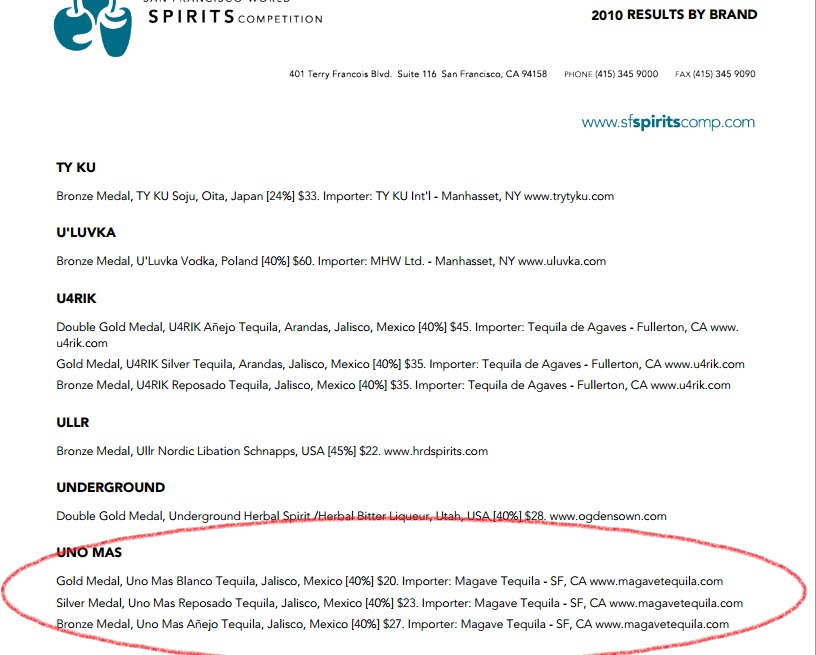
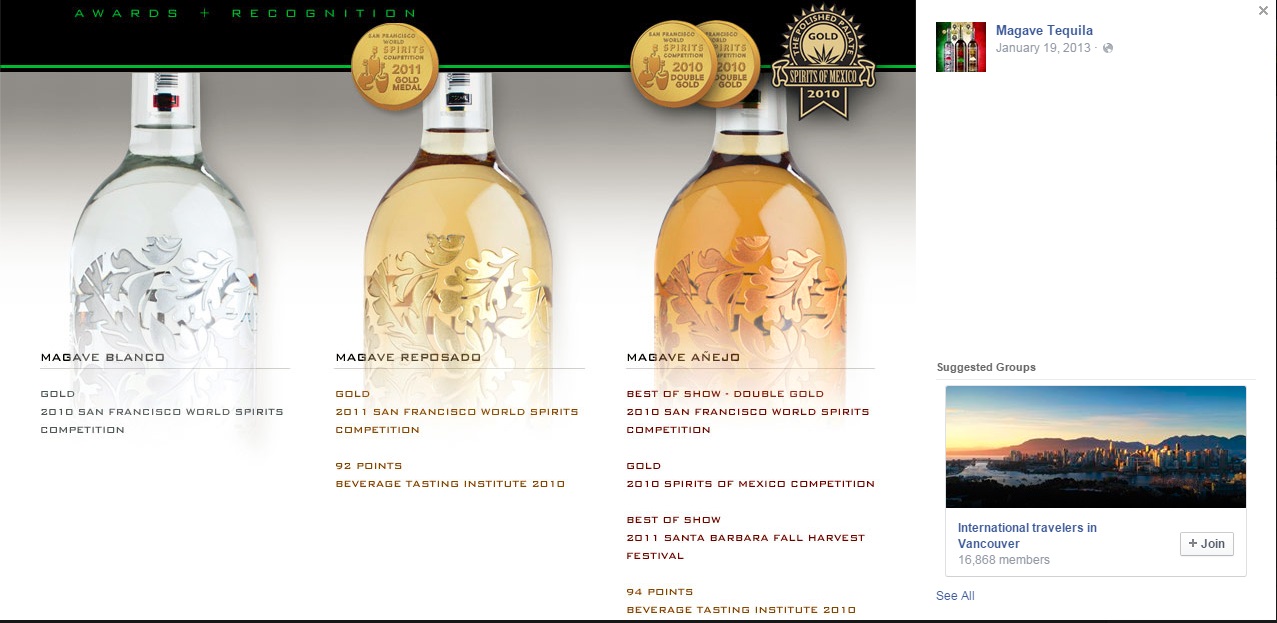
A few years back I bought a bottle of Uno Mas Anejo tequila at a private liquor store in Vancouver, British Columbia, Canada to take to a birthday party. I thought it was just OK besides it ended up in some margaritas anyways. But what bothered me was the importer of this particular offering advertised it as a "Double Gold" medal winner at the 2010 San Francisco World Spirits Competition. The research into this particular matter wasn't that difficult as the San Francisco World Spirits Competition archives its results on its website.

Simply put, the archived results contradicted things. Curious. Thinking there was some type of mistake, I emailed both the San Francisco World Spirits Competition and the brand Uno Mas tequila. The email response(s) were somewhat laughable. The phone conversations with SFWSC's representative and the tequila brand spokesperson are another story entirely.


The explanation given by the tequila brand spokesperson doesn't make any sense whatsoever if in fact the Uno Mas Anejo is really the same recipe & aged agave disillate as the Mujer Bonita. I guess anything is possible. The funny this is that three different tequila brands (Mujer Bonita, Magave, Uno Mas) were submitted by the same company/brand owner into the 2010 San Francisco World Spirits Competition with varying different results.


In fact it does appear that the brand(s) and a few of its importers still advertise on various social media the prominent awards that have been "won" at the San Francisco World Spirits Competition. Even-though the brand owner has clearly "cherry-picked" from the results of its stable of brands - active or defunct - submitted into the competition.


Lorenz Agave Spirits

This sort of willful (somewhat fraudulent) behavior usually doesn't bother me but what does is that some consumers out there just assume or regard a competition like the San Francisco World Spirits Competition as wholly reputable. The fact that something like 90% of the brands submitted into the San Francisco World Spirits Competition are awarded a medal is a real eye-opener. Especially when you factor in the $475 USD entry fee per spirit, $100 USD entry fee per packaging design, one-time licensing fee $200 USD per award level, and whatever fee for a roll of SFWSC award stickers.

Not surprisingly both parties have since changed their tune on this matter. The San Francisco World Spirits Competition expressed concern over such misuse of its medals so I guess we can expect some type of due diligence in such future matters involving their awards. The brand owner of Mujer Bonita, Magave and Uno Mas now says it was all just a clerical mistake. Make no mistake there are unasked questions, inconsistencies and downright lies that should make you question the narrative of a competition like the San Francisco World Spirits Competition.